DOGE restructuring, disputed savings claims and service disruption
Editorial record through October 30, 2026. Later developments are not reflected here.
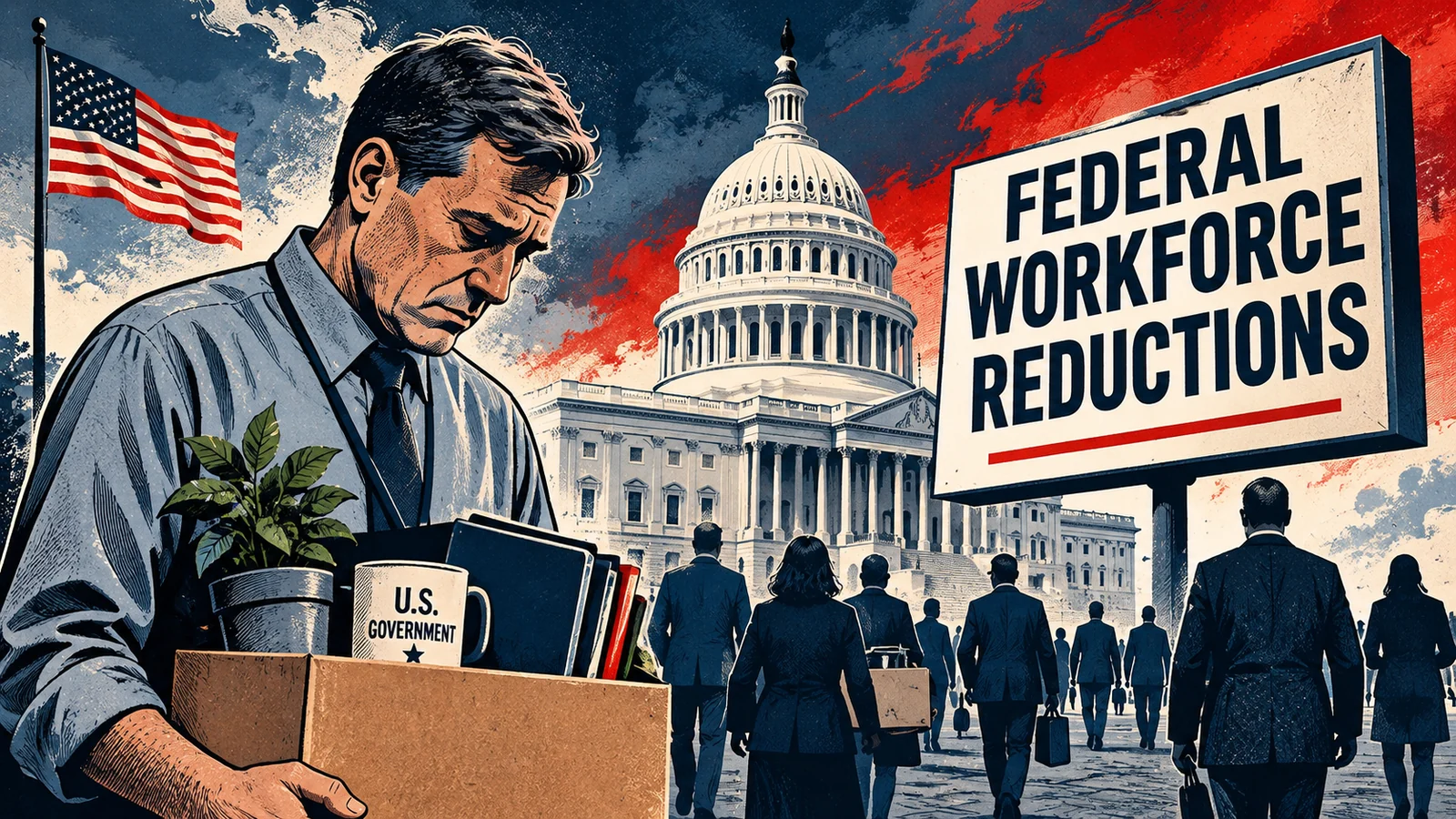
Remember when?
Beginning in January 2025, federal agencies acted on presidential and OPM directives to reassess probationary employees and cut staffing. GAO examined eleven agencies with health and safety missions and reported in June 2026 that probationary employees at most of the selected agencies separated at higher rates than the overall workforce during 2025 (19% versus 15% across the sample); most separations were voluntary. Different agencies had different employment patterns and legal challenges.
GAO’s separate analysis of 22 major agencies found nearly 378,000 employee separations in 2025 and roughly 127,000 hires, with a net workforce decline of nearly 256,000 between December 2024 and January 2026. These separations included voluntary resignations and retirements, not just terminations; treating the whole figure as people fired would misstate the record.
What happened and why it drew scrutiny
The Department of Government Efficiency initiative pursued rapid contract cancellations, agency restructuring and personnel reductions. Critics challenged the way savings were calculated or publicized and documented cases of reversed decisions and attempted rehiring. Any numeric savings claim or reported rehire should be tied to its particular agency, date and source rather than generalized across the entire federal workforce.
Why it matters
Sudden changes may weaken professional expertise, public-service continuity and statutory civil-service protections.
The practical consequences depend on which positions were eliminated, whether agencies could transfer responsibilities, and how quickly they could restore needed capacity. Workforce totals alone do not establish that a particular service failed, but they do identify where service disruption and loss of institutional knowledge warrant examination.
Administration response and important qualifications
The administration argued it was improving efficiency and personnel accountability. GAO describes separations and policy changes; its statistical report does not hold that every reduction or probationary dismissal was unlawful.
Start with the evidence
- OPM: memoranda and workforce directives (primary-document index) ↗
Source type: Agency actions and litigation. Read the underlying material and its limits before drawing a legal conclusion.
- GAO-26-108557, workforce reductions at health and safety agencies ↗
Specific June 2026 GAO analysis of 2025 probationary employee separations; not a finding that every removal was unlawful.
- White House workforce optimization executive order, February 11, 2025
Additional records and qualifications
GAO reports that 2025 directives and OPM guidance changed probationary-employee reviews and workforce staffing. At eleven selected agencies, GAO found probationary separations of 19% versus 15% for the overall workforce; more than two-thirds of probationary separations were voluntary. This sample should not be represented as a government-wide probationary dismissal rate. GAO also reported nearly 378,000 total separations and about 127,000 hires across federal agencies in 2025; separations are not synonymous with firings. The administration framed the changes as efficiency and accountability measures. Concerns about lost expertise and service disruption are plausible policy assessments, not measured consequences established by this GAO probationary-employment report. OPM's March 2025 clarification said agencies, rather than OPM, retained ultimate decision-making authority over individual personnel actions. Legal challenges varied, and GAO's statistical analysis did not declare every personnel action unlawful.
- GAO: Federal workforce changes during 2025
- GAO: Workforce changes, January–June 2025
- OPM: January 20, 2025 probationary-period guidance
- OPM: March 4, 2025 clarification
GAO-26-108557: GAO reported 19% probationary separations versus 15% overall across 11 selected agencies in 2025. More than two-thirds of separating probationary employees left voluntarily. Not a government-wide firing rate. Read original GAO report
GAO-26-108719: Earlier Jan–Jun 2025 snapshot: roughly 134,000 separations and 66,000 hires, plus 144,000 deferred resignations approved for later departure. Do not add the latter to annual separation counts; different reporting windows overlap. Read original GAO report
A September 2026 GAO review estimated $9.5 billion in federal paid-administrative-leave salary costs during 2025 across the agencies reviewed, approximately $6.7 billion of which GAO associated with the deferred resignation program. These are salary costs paid during leave, not a finding that the entire amount was unlawful, wasted, or incremental to salaries that otherwise would have been paid. GAO said payroll reporting limitations prevented OPM from knowing the precise costs attributable to workforce-reduction leave.
GAO-26-108477 original reportGAO original report highlights and separation-type table